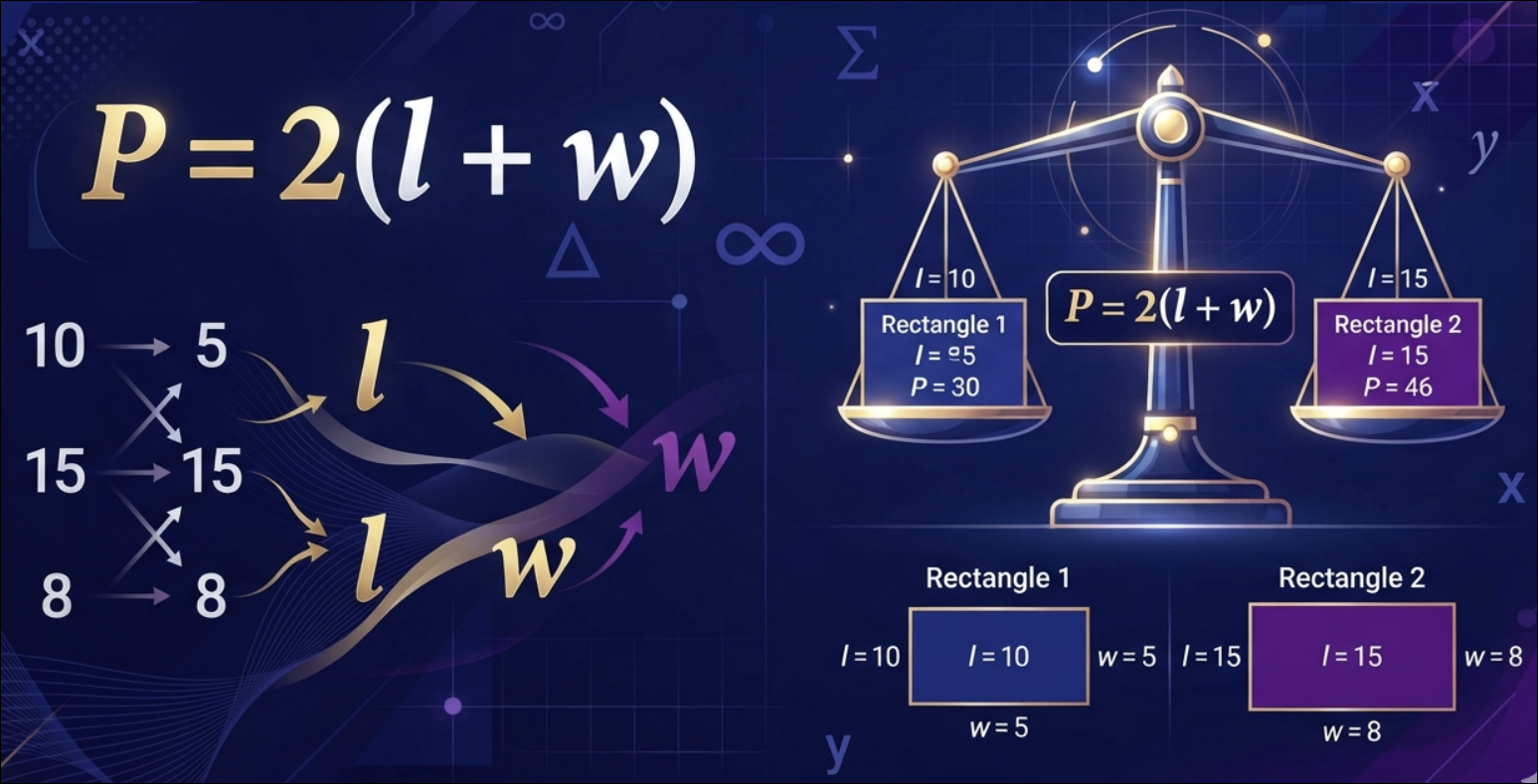
 Visual representation of how algebra transforms specific numbers into general relationships. The balance scale demonstrates equality preservation, while rectangles show concrete examples transforming into variables.
Why This Matters
You’ve learned the multiplication formula for area: length × width. But then you see this:
A = l × w
Why use letters? It looks more complicated.
Here’s the truth: Algebra doesn’t make math harder—it makes relationships visible. Once you see the relationship, you can apply it to infinite situations without memorizing infinite formulas.
What You’ll Learn
By the end of this article, you’ll understand:
- Why
xrepresents not “a mystery” but “any value in a relationship” - How the same relationship looks different in different representations
- Why preserving relationships lets you solve problems you’ve never seen before
- The connection between algebraic manipulation and data transformations in code
1. From Specific to General: A Real Problem
The Concrete Problem
You’re buying fence posts for a rectangular garden:
– Garden 1: 10 meters long, 5 meters wide → Perimeter = 10+5+10+5 = 30 meters
– Garden 2: 15 meters long, 8 meters wide → Perimeter = 15+8+15+8 = 46 meters
– Garden 3: 20 meters long, 12 meters wide → Perimeter = 20+12+20+12 = 64 meters
You notice a pattern: you’re always adding the length twice and the width twice.
Arithmetic approach: Memorize the answer for every possible garden size.
Algebraic approach: See the relationship once, apply it forever.
Spotting the Relationship
The pattern is:
Perimeter = length + width + length + width
         = 2 × length + 2 × width
         = 2 × (length + width)
Now replace the specific numbers with variables that can hold any value:
P = 2(l + w)
This isn’t “abstract nonsense”—it’s a compressed description of infinite specific cases.
2. The Power: Same Relationship, Multiple Representations
Here’s the key insight: The relationship P = 2(l + w) is true, regardless of how you write it.
Four Equivalent Forms
- Standard form: P = 2(l + w)
- Expanded form: P = 2l + 2w
- Solving for length: l = (P – 2w)/2
- Solving for width: w = (P – 2l)/2
All four say the SAME thing. They just emphasize different aspects. Watch:
| Scenario | Best Form | Why |
|---|---|---|
| You know length and width, want perimeter | P = 2(l + w) | Direct calculation |
| You know perimeter and width, want length | l = (P – 2w)/2 | Isolates l |
| Checking if your formula works | P = 2l + 2w | Shows symmetry between l and w |
Critical insight: Transforming an equation doesn’t change the relationship—it changes what’s easy to see.
3. Transformation Rules: Why They Preserve Truth
When you manipulate an algebraic equation, you’re not “doing random operations.” You’re applying transformations that preserve the relationship.
The Balance Scale Analogy
Think of an equation as a balance scale:
2x + 5 = 13
The scale is balanced (equals sign = balance point).
Rule: Whatever you do to one side, do to the other. The balance is preserved.
Subtract 5 from both sides:
    2x + 5 - 5 = 13 - 5
    2x = 8

Divide both sides by 2:
    2x/2 = 8/2
    x = 4
Why this matters: These aren’t “tricks”—they’re operations that preserve equality.
What Breaks the Relationship
Invalid operations destroy the relationship:
2x + 5 = 13

Wrong: Divide left by 2, subtract 5 from right
   x + 5 ≠ 8

Right: Same operation both sides
   x = 4
Failure mode demonstrated: Unequal operations break equality.
4. Worked Example: Solving a Real Problem
Problem: A garden’s perimeter is 50 meters. The length is 3 meters more than twice the width. What are the dimensions?
Step 1: Express the relationships
From the problem:
1. P = 2(l + w) = 50
2. l = 2w + 3
Step 2: Substitute to eliminate one variable
Replace l in equation 1:
2((2w + 3) + w) = 50
Step 3: Simplify
2(3w + 3) = 50
6w + 6 = 50
Step 4: Isolate w
6w = 50 - 6
6w = 44
w = 44/6 = 7.33 meters
Step 5: Find l
l = 2(7.33) + 3 = 17.67 meters
Step 6: Verify
P = 2(17.67 + 7.33) = 2(25) = 50 ✓
The relationship holds.
5. Implementation: Algebra as Code
Algebraic transformations are exactly what happens in data pipelines and mathematical code.
# The algebraic relationship as a function
def perimeter(length, width):
    """Calculate perimeter of rectangle."""
    return 2 * (length + width)

# Test with known values
print(f"Garden 1: {perimeter(10, 5)} meters")  # 30
print(f"Garden 2: {perimeter(15, 8)} meters")  # 46
print(f"Garden 3: {perimeter(20, 12)} meters") # 64

# Inverse relationship: given perimeter and width, find length
def length_from_perimeter(perimeter, width):
    """Solve for length: l = (P - 2w)/2"""
    return (perimeter - 2*width) / 2

# Verify
P = 50
w = 7.33
l = length_from_perimeter(P, w)
print(f"\nGiven P={P}, w={w:.2f}")
print(f"Calculated length: {l:.2f} meters")
print(f"Verification: {perimeter(l, w):.2f} meters")
Output:
Garden 1: 30 meters
Garden 2: 46 meters
Garden 3: 64 meters

Given P=50, w=7.33
Calculated length: 17.67 meters
Verification: 50.00 meters
6. When Algebra Breaks: Non-Reversible Operations
Some transformations LOSE information:
Example: Squaring Both Sides
x = 3
x² = 9    [true]

But also:
x = -3
x² = 9    [also true!]
The problem: Squaring is not reversible—you lose the sign. When you square both sides, you introduce extraneous solutions.
Algebraic lesson: Not all transformations preserve all information. Some create ambiguity.
Example: Dividing by a Variable
Solve: x² = x

Wrong approach:
x²/x = x/x
x = 1

But x = 0 is also a solution!
What happened: Dividing by x assumes x ≠ 0. You excluded a valid solution.
Right approach:
x² - x = 0
x(x - 1) = 0
x = 0  or  x = 1
7. Cross-Domain Connections
Statistics: Formula Manipulation
In STAT-100.1: What Does Data Tell Us?, we calculated mean and variance. Those are algebraic relationships:
Mean: μ = (x₁ + x₂ + ... + xₙ) / n
Different form, same meaning:
μ = (1/n) × Σxᵢ
Code: Data Transformations
In CODE-100.3: Functions, you’ll see function composition:
def double(x):
    return 2*x

def add_five(x):
    return x + 5

# Composition: (add_five ∘ double)(x) = add_five(double(x))
result = add_five(double(3))  # 2*3 + 5 = 11
This is algebraic substitution in code.
Machine Learning: Loss Functions
In ML-100.1: What Does Learning Mean?, models minimize loss functions. The loss function is an algebraic relationship between predictions and true values:
MSE = (1/n) Σ(yᵢ - ŷᵢ)²
Optimizing this means taking derivatives—pure algebra.
8. Pattern Passport
Pattern Observed: TRANSFORMATION
How It Appears Here:
– Same relationship, multiple forms (P = 2(l+w) = 2l + 2w)
– Equivalent transformations preserve the relationship
– Non-equivalent operations break it
Representation:
– Algebraic equations with variables
– Each form emphasizes different aspects (solving for different variables)
Transformation Rules:
– Equal operations both sides → preserves equality
– Unequal operations → breaks equality
– Non-reversible operations (squaring, dividing by zero) → lose information
Assumptions:
– Variables represent numbers (unless otherwise specified)
– Operations follow arithmetic rules
– Denominators ≠ 0
Failure Conditions:
– Dividing by zero
– Taking even roots of negative numbers (in real numbers)
– Dividing by a variable without checking if it could be zero
Related Disciplines:
– Statistics STAT-100.1: Formulas for mean, variance are algebraic relationships
– Code CODE-100.3: Function composition is algebraic substitution
– Machine Learning ML-100.1: Loss functions are equations to minimize
– Data DATA-200.3: Data transformations preserve relationships between fields
Next Learning Steps:
1. MATH-100.3: Functions — Functions formalize the input-output relationship
2. MATH-100.4: Linear Relationships — A special case where relationships are straight lines
9. Summary: Why Algebra Matters
Algebra is not about “solving for x”—it’s about seeing relationships that hold across infinite cases.
Three key insights:
- Variables generalize:
xmeans “any value in this relationship” - Equivalent forms: Same relationship, different emphases
- Transformation preserve truth: Valid operations keep the relationship intact
When algebra breaks:
– Non-reversible operations (squaring, absolute value)
– Dividing by expressions that could be zero
– Assuming domain restrictions don’t apply
The power: Once you see a relationship algebraically, you can apply it to any specific case—in math, statistics, code, machine learning, or data transformations.
10. Exercises
-
Transform and verify: Start with
3x + 7 = 22. Show three equivalent forms, and verify with x=5. -
Build a relationship: The area of a triangle is “half the base times the height.” Write this algebraically, then solve for height given area and base.
-
Find the error:
x²/x = x
   x = 1
Why is x=0 excluded? How do you fix it? -
Code it: Write a Python function that takes perimeter and length, returns width. Test it.
Revision History
2026-07-30: Substantially revised to include cross-domain connections to statistics, code, ML, and data. Added failure mode demonstrations. Improved code examples.
2024-04-15: Originally published.
Reproducible Code
All code in this article is available at:
– Code/algebra_examples.py — All worked examples
– validation/test_algebra.py — Automated tests verifying all claims
Run tests:
cd Categories/01-Mathematics/100.2-From-Numbers-to-Relationships
python validation/test_algebra.py